Why Residential OCD Treatment in South Africa Works When the Shortcuts Don’t
You have probably already tried the shortcuts. A ketamine infusion that quieted the noise for an afternoon. A psilocybin experience that felt like a breakthrough until the doubt crept back. A short course of EMDR. A round of TMS. Each was a genuine, hopeful attempt, and some may have a real place in OCD care. But if the checking, washing, mental reviewing and reassurance-seeking are still running your day, you have met the pattern most people with OCD discover the hard way: OCD is rarely defeated by a single intervention. It is defeated by learning, repeated until the nervous system believes it.
That is why people travel from around the world searching for a top OCD recovery centre. Not another shortcut, but a place where Exposure and Response Prevention (ERP), Acceptance and Commitment Therapy (ACT) and deeper identity-level work happen together, every day, in a setting that feels safe. At the Center for Healing and Life Transformation (CHALT) in Knysna, on South Africa’s Garden Route, we run one of the country’s few specialised residential OCD programs for adults and adolescents, built around the 12-module Paradigm Process OCD Recovery Program.
The OCD Shortcut Trap: Ketamine, Psilocybin, TMS and EMDR
When outpatient therapy has not been enough, it is completely understandable to look for something faster. The problem is not that these options are worthless. The problem is that on their own, none of them teaches the brain the one thing OCD recovery requires: that you can feel the doubt, drop the ritual, and be okay.
Here is an honest summary of where each stands for OCD, based on current research and guidance from the International OCD Foundation (IOCDF):
| Approach | Where it stands for OCD | Where it fits |
|---|---|---|
| ERP | The first-line treatment with the strongest research support | The foundation of recovery |
| ACT | Evidence-supported; widely used alongside ERP to build willingness and reduce struggle with thoughts | Works with ERP, not instead of it |
| TMS | FDA-cleared for some adults with OCD who have not responded to medication or ERP; response rates vary widely between studies | A possible option for treatment-resistant cases, alongside therapy |
| Ketamine | Not approved for OCD; evidence is limited and effects are usually short-lived on their own | Experimental; some early work explores pairing it with ERP |
| Psilocybin | Not approved for OCD; no large randomised trials yet, and benefits appear shorter-lived in OCD than in some other conditions | Experimental; research is ongoing |
| EMDR | Well established for trauma, but IOCDF treatment guidance lists it among approaches not found effective for OCD | Useful if trauma is also present, not a substitute for ERP |
Why shortcuts stall without proper OCD treatment
Relief is not learning. A medication, infusion or stimulation protocol can turn the volume down. It does not, by itself, retrain your response to uncertainty. When the effect fades, the compulsive habits are still there.
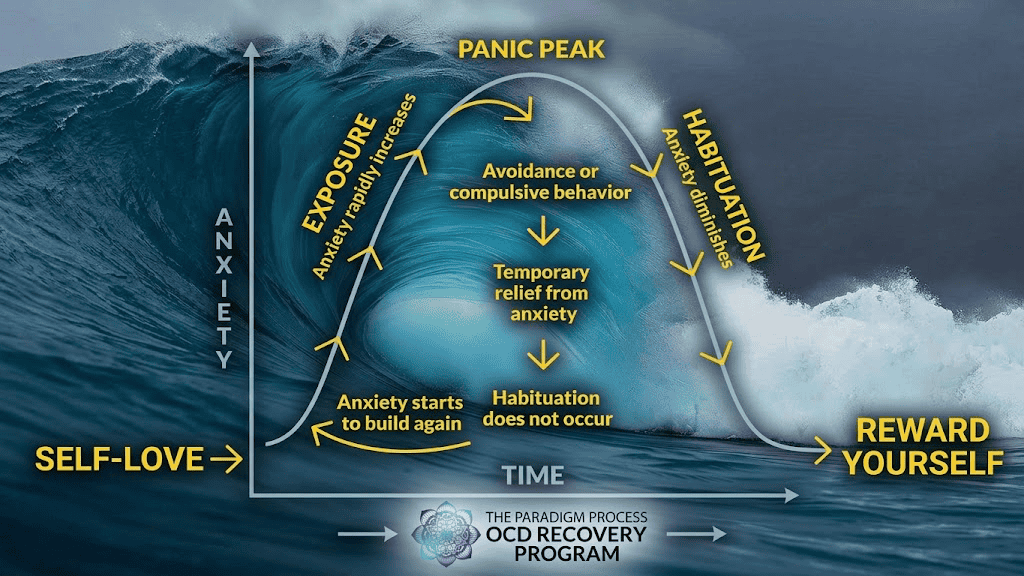
The ritual loop stays intact. OCD runs on a loop: trigger, obsession, urgency, compulsion, relief. Unless the compulsions and avoidance are actively dismantled through exposure and response prevention, the loop keeps its fuel.
Nothing addresses the identity beneath the symptoms. Many people with OCD carry rigid inner rules about control, perfection and responsibility. Those survival patterns need attention too, or recovery stays fragile.
There is a hopeful side to this. In one review of psychedelic-assisted therapy for OCD, researchers noted that even where symptom relief did not last, participants seemed more open to evidence-based treatment afterwards. In other words, a shortcut can open a window. What you do with that window is what counts. (If you are on medication, never change or stop it without your prescriber’s advice.)
What Real OCD Recovery Requires
Effective OCD treatment has three non-negotiables:
- Exposure and Response Prevention (ERP): deliberately facing feared triggers while resisting the compulsion, until the brain’s false alarm quietens.
- Acceptance and Commitment Therapy (ACT): learning to unhook from intrusive thoughts and choose values-driven action instead of fear-driven control.
- Intensity and consistency: daily practice with expert guidance, which is exactly what a weekly 50-minute session struggles to provide.
This is where residential treatment earns its place. Published research on specialised residential programs suggests they can be effective for treatment-refractory OCD (see this naturalistic study of 46 adults), and a three-week inpatient ERP study found effects similar to longer residential programs, while concluding that better relapse-prevention work is still needed. That last point is one we took seriously when designing our program.
Inside CHALT’s Residential OCD Program in South Africa
Our 12-module residential OCD recovery roadmap moves clients through four movements, each blending clinical practice with somatic and contemplative work:
- Movement 1, Awareness (Modules 1–2): map your personal OCD loop and recognise intrusive thoughts as mental events, not commands.
- Movement 2, Acceptance (Modules 3–4): values clarification, cognitive defusion and the “not required right now” protocol.
- Movement 3, Action (Modules 5–8): a structured ERP fear hierarchy, response prevention, deliberate rule-breaking and deeper work on control and perfectionism.
- Movement 4, Integration (Modules 9–12): Contemplative Intelligence, real-world exposure, flare-up mastery, relapse prevention and a personal aftercare plan.
Every day also engages four pillars: Physical (exercise, sleep routines, Garden Route hikes, kinesiology and nutrition support), Psychological (individual and group ERP and ACT with our psychotherapists), Emotional (group process, journaling and building tolerance for vulnerability) and Spiritual (CQ Meditation and the Paradigm Process).

What Makes the Paradigm Process OCD Recovery Program Different
The Paradigm Process was developed by Mark L. Lockwood, BA(Hons)(Psy), Life Strategist and Founder and Clinical Director of CHALT, with more than 25 years of experience. It began as a framework for chronic addiction and now underpins our OCD program. It is a coaching and life-strategy framework, not a replacement for clinical care: at CHALT it runs alongside ERP and ACT delivered by our psychotherapists.
Its focus is the architecture underneath OCD. The framework identifies survival-based personality patterns, called Ego Insurgents, such as The Controller and The Perfectionist, that formed to keep us safe but now feed OCD’s demand for certainty. Clients learn to recognise these patterns and move toward their counterparts, such as self-love in place of control and gratitude in place of perfectionism, grounding recovery in what we call the Sacred Self. As Mark puts it: “We don’t treat the wound, we get under it.” Learn more about the Paradigm Process OCD program we use at our Top OCD Recovery Centre.
How to Choose the Best OCD Recovery Centre in the World
Whether you are considering us or anyone else, use this checklist:
- Does it specialise in OCD? Many centres offer “intensive programs” without real OCD expertise.
- Is ERP delivered daily, not just mentioned in a brochure?
- Is ACT included to address the thought-struggle that ERP alone can leave behind?
- Are the clinicians qualified, and is the clinical team clear about who does what?
- Is family involved? Accommodation at home can keep OCD alive after discharge.
- Is there a real relapse-prevention and aftercare plan?
- Does the environment support a nervous system under threat? Privacy, calm and dignity matter.
- Is the centre honest about the evidence, including what new treatments can and cannot do?
Large hospital-based programs in North America, the UK and Australia are well known. CHALT offers something totally private, non-medical, non-formal and different: a small, private, home-styled setting, clinical intensity paired with whole-person work, and a program built to hold after you go home.

Why Knysna: Privacy and Seclusion for Clients Worldwide
CHALT sits on the Garden Route, away from the triggers of daily life. Clients from more than 30 countries have travelled here for the combination of clinical intensity and genuine seclusion. For executives, public figures and their families, that discretion is often the deciding factor.
Adults, Adolescents and Families
We holistically treat adults with moderate to severe OCD, including treatment-resistant cases, and adolescents with age-appropriate adaptations to ERP and family involvement. We help people who have tried, don’t want, refuse or wouldn’t consider main stream clinics and have their doctors support on the holistic approach we provide. Our parallel Family & Support Program teaches loved ones to stop reassurance-seeking and household accommodation, and become recovery allies. See also our Youth and Adolescent Development Program.
Frequently Asked Questions
What is the best treatment for OCD? Exposure and Response Prevention (ERP) is the first-line treatment with the strongest research support, often combined with Acceptance and Commitment Therapy (ACT) and, for some people, medication prescribed by a doctor. No shortcuts. Just damn hard work at a Top OCD Recovery Centre.
Do ketamine, psilocybin, TMS or EMDR cure OCD? Unfortunately no. None is a standalone cure for OCD. TMS is cleared for some adults with treatment-resistant OCD, ketamine and psilocybin remain experimental for OCD, and EMDR has not been found effective for OCD. All work best, if at all, alongside ERP-based therapy. Life on lifes terms means hard work, commitment, dedication and practice are all needed. You also need to keep recovery first!
Is residential OCD treatment worth it? It can be, particularly for severe or treatment-resistant OCD, when outpatient therapy has not been enough, or when home triggers and family accommodation keep the cycle going. Daily guided exposure work is the main advantage. The second advantage is having the time, space and the power of the OCD program.
What is the best OCD treatment centre in South Africa? The right centre is one that specialises in OCD, delivers ERP and ACT daily, involves family and plans aftercare. You can choose a clinic or similar which we are not. We are purely a wellness centre which provides a home away from home and nothing at all medical. Our local professionals support all those needs. We stick to running our private and holistic OCD program and healping people heal one of the toughest darn issues out there. CHALT in Knysna is one of South Africa’s few specialised residential OCD programs, built on these principles.
Do you treat adolescents as well as adults? Yes. We work with adults and adolescents, adapting ERP delivery and family involvement to age and severity.
How long is the residential OCD program? CHALT’s residential OCD program runs for 90 days and is structured as 12 modules across four movements: Awareness, Acceptance, Action and Integration. A personal aftercare plan is built before you go home.
Can international clients attend CHALT? Yes. Clients from more than 30 countries have travelled to Knysna for treatment. Contact us for guidance on travel and intake.
What is the Paradigm Process OCD Recovery Program? It is a 12-module framework developed by Mark L. Lockwood that works alongside ERP and ACT, targeting the survival-based ego patterns that keep OCD’s obsession-compulsion loop running.
Conclusion: Skip the Shortcuts, Find the Foundation
Ketamine, psilocybin, TMS and EMDR each have stories and, in some cases, a legitimate role. But Top OCD Recovery Centre programs like ours do not come from any single intervention. It comes from learning, through repeated, guided experience, that uncertainty is survivable. That is what ERP, ACT and the Paradigm Process deliver together, in a private setting designed for your nervous system to feel safe enough to change. If you or someone you love is searching for a top OCD recovery centre, book a confidential intake assessment and let us show you what the foundation looks like.

The information on this website is for educational purposes only and our completely modern Top OCD Recovery Centre programs for OCD are not a substitute for professional medical advice, diagnosis or treatment. The Paradigm Process is a coaching and life-strategy framework. Always consult your physician or qualified healthcare provider about your condition and never stop or change medication without medical advice.
